
English| EUR
Suggested for you
More currencies
Choose a language
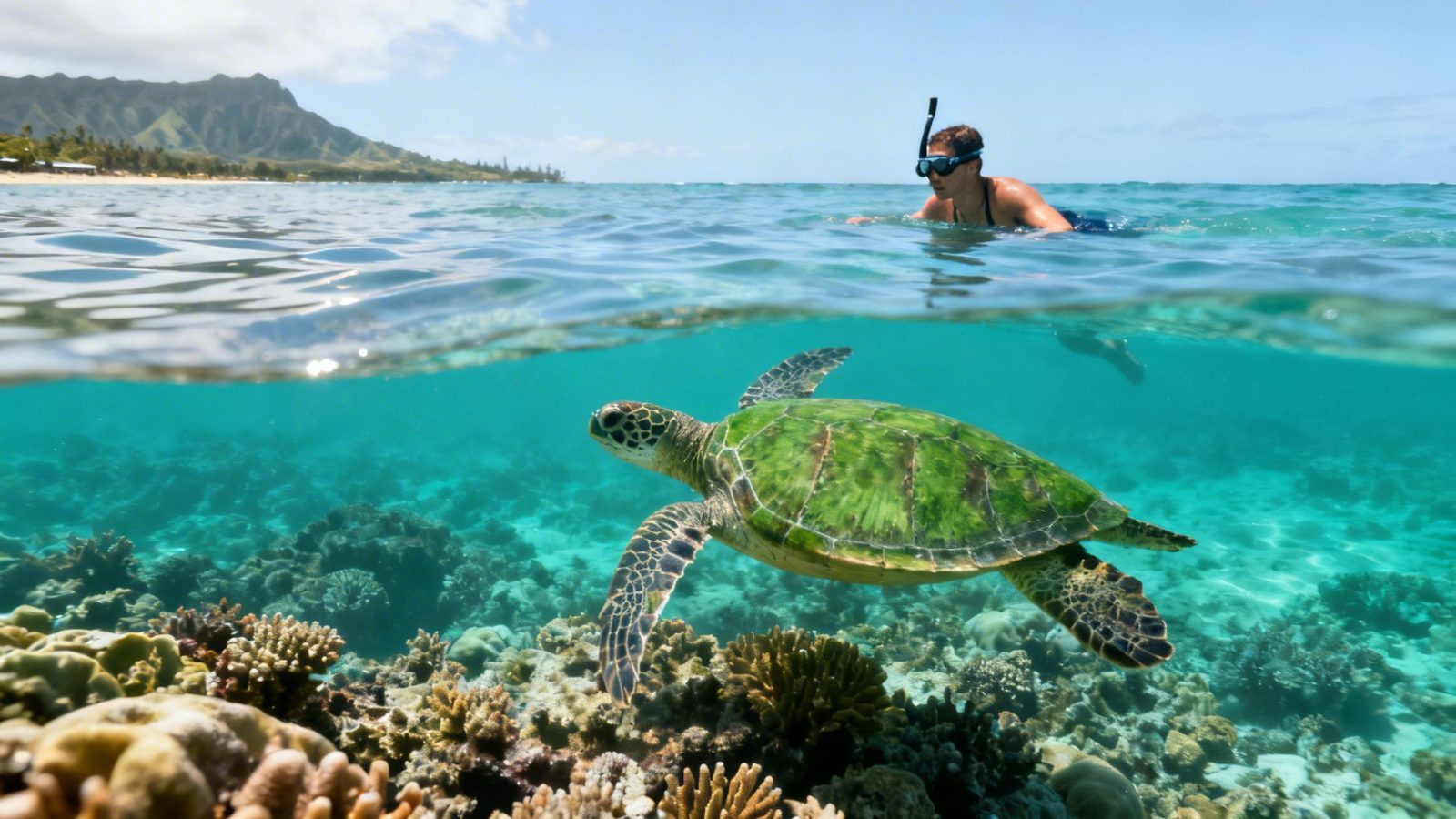
Waikiki's honu are not staged. They graze a shallow limestone reef that runs the length of the shoreline, and they surface where the algae grows, not where the crowds gather. This where to see turtles in waikiki guide maps the reliable stretches, the arrival window that gives you clear water, and the legal distance that keeps the encounter lawful.
Quick answer
The most reliable answer to where to see turtles in waikiki is the reef flat off Queen's Beach and the Kapiolani Park end of the shoreline, reached from Waikiki Beach, Honolulu, HI 96815, USA. Public beach access is free and open around the clock. Arrive between 07:00 and 10:00, when water clarity is highest and wind chop is least likely.
Hawaiian green sea turtles, called honu, were listed as threatened in 1978 after decades of harvest; the Oahu population has recovered enough that a swimmer standing chest-deep off Kaimana Beach in August 2026 has a genuine chance of one surfacing within a few metres. That recovery is why the question of where to see turtles in waikiki has a real answer instead of a hopeful one. Honu are herbivores. They follow limu, the algae that coats the limestone reef flat, and that flat sits closer to shore than most visitors expect. The shoreline is not uniform. West of the Royal Hawaiian, the seabed is largely sand and heavily churned by surf schools and outrigger canoes; turtles pass through but rarely linger. East of the Natatorium, past Queen's Beach toward Kaimana and the edge of Kapiolani Park, the reef sits shallow and the limu grows thick. Those Waikiki turtle snorkeling spots are the ones locals name first. Turtle Canyon, a cleaning station roughly a mile offshore of Diamond Head, holds more animals still, but it is boat-access only and belongs to a different kind of morning. Anyone comparing shore snorkelling against a Waikiki snorkel tour should understand the trade: the reef flat costs nothing and rewards patience, while the offshore site trades effort for density. Conditions govern everything. Trade winds usually build through the day, so surface chop and suspended sand rise with them, and visibility over the reef drops accordingly. Tide matters too; a very low tide leaves the flat too shallow to swim without contacting coral, which damages the reef and is best avoided entirely. Wrasses and yellow tangs working the same substrate are a good sign that the limu is healthy and honu are nearby. Once a turtle appears, the rules are federal. NOAA guidance asks viewers to stay at least ten feet away in the water and remain passive: no touching, no chasing, no positioning yourself over a surfacing animal, since honu must breathe. Turtles hauled out on sand are resting, not stranded, and should be left alone behind a wider buffer. Treated this way, where to see turtles in waikiki becomes less a hunt than a matter of being in the right water at the right hour and letting the reef do the rest. Diamond Head on the horizon, the flat underfoot, and a shadow moving beneath you.
“Honu are herbivores. They follow limu, the algae that coats the limestone reef flat, and that flat sits closer to shore than most visitors expect.”
The best arrival window is 07:00–10:00, as this period offers clearer water and lower probability of wind-driven choppiness for snorkeling. Visiting during these early hours provides the most stable conditions to observe marine life near the shore.
—
Fewer beachgoers create a quieter environment for turtle spotting.
75°F to 80°F, calm seas
Spring offers stable weather and comfortable water temperatures.
77°F to 82°F, mild winds
Fall transitions often feature calm, clear water conducive to snorkeling.
Verdict: The best slot for turtle sightings is weekday mornings between 07:00 and 10:00 during the months of April, May, October, or November.
Waikiki Beach is located along the southern shore of Honolulu, with public access points available along Kalakaua Avenue. The most direct approach for snorkeling is to enter via the beach access paths located near the Waikiki Wall or the area fronting the Honolulu Zoo.
TheBus routes 2, 20, or 42 to Kalakaua Ave/Koa Ave stop
I-H-1 E to Honolulu, exit 23 onto Punahou St
Walk via public beach access paths from Kalakaua Avenue
For the best chance to see turtles, aim to arrive during the designated best arrival window to minimize crowds and secure parking at public lots near the Honolulu Zoo or Kapiolani Park.
Hawaiian green sea turtles (honu) are protected under the federal Endangered Species Act, the Marine Mammal-era wildlife statutes administered by NOAA, and Hawaii state law, which together make harassment a finable offense. NOAA advises staying at least 10 feet from turtles in the water and on shore, and violations at Waikiki Beach can carry penalties into the thousands of dollars.
A short gear list keeps a Waikiki turtle snorkel simple, since the beach itself is free and open, and the only real preparation is what you bring in your bag.
Everything you need to know about where to see turtles in waikiki
You can find Hawaiian green sea turtles, or honu, by snorkeling in the protected shallow areas along the coastline. Knowing where to see turtles in waikiki often involves scanning for rocks that move or bobbing heads near the reef. Always maintain a respectful distance to ensure the safety of these protected marine animals.
For the clearest water and the best chance to spot marine life, you should aim to arrive during the morning window between 07:00 and 10:00. This period typically features less wind-driven choppiness, making it easier to observe the reef clearly. Finding out where to see turtles in waikiki is much easier when the visibility is high.
Access to the beach itself is completely free for everyone. There is an entrance fee of 0 USD for all public beaches in the area. This makes it an accessible location for those wondering where to see turtles in waikiki on a budget.
It is illegal to touch, chase, or harass sea turtles in Hawaii as they are a protected species. Please observe them from a distance of at least 10 feet at all times. Federal and state laws strictly protect these creatures to ensure their health in the wild.
Bring your own snorkeling gear, such as a mask, snorkel, and fins, to improve your underwater experience. If you are not a strong swimmer, consider a flotation device for added safety while exploring the reef. Protecting your skin with reef-safe sunscreen is also an important step for marine conservation.
While many visitors head out on their own, there are several local boat and snorkel operators that offer professional excursions. These guided experiences can help you navigate the reef safely while providing local insight into marine behavior. Booking a tour is a great way to maximize your chances of a sighting.
Public transportation and taxis frequently serve the Waikiki area, dropping visitors near various access points along the beach. Once you arrive at the address, Waikiki Beach, Honolulu, HI 96815, USA, you can walk to the shoreline to start your search. Checking maps or local transit apps will help you plan your commute to the coast.
Cost to Swim with Turtles
Read more Tickets & toursSunset Turtle Snorkeling Cruise
Read more GuideWaikiki Turtle Snorkeling Reviews
Read more Tickets & toursTurtle Canyon Snorkeling Tour
Read more Tickets & toursCatamaran Turtle Snorkeling
Read more Tickets & toursSnorkeling Boat Cruises
Read more